How Schools Can Kick Off World Space Week With Forces, Motion, and Flight

World Space Week is an ideal opportunity for schools to inspire curiosity and achievement in STEM by focusing on the fundamentals of forces, motion, and flight. The most effective way to launch this celebration is to engage students with immersive, high-impact science experiences that demonstrate real-world applications of these concepts. School assemblies that bring in expert educators, such as the highly acclaimed Extreme Science program, set the tone for a week of dynamic, hands-on learning that stays with students long after the event ends.
Extensive educational feedback and testimonials show that live science assemblies—especially those packed with interactive demonstrations and humor—are among the most engaging methods for connecting abstract classroom science to the excitement of space exploration. When assemblies focus on air pressure, gravity, Newton’s laws, and the mechanics of flight, students not only celebrate World Space Week, but also see physics in action in ways that are directly relevant to their curriculum.
What Is World Space Week and Why Is It Important for Schools?
World Space Week is an annual celebration of science and technology, recognized globally from October 4 to 10. It is designed to enhance public understanding and enthusiasm for space exploration and its contributions to society. For schools, this week provides a framework to amplify STEM learning, align with Next Generation Science Standards, and foster long-term interest in physics, engineering, and aerospace careers.
How Can Forces, Motion, and Flight Spark Student Engagement During World Space Week?
Forces, motion, and flight are central to understanding how humans explore space. By grounding World Space Week activities in these core topics, schools can offer students a hands-on introduction to physics and engineering concepts that underpin rocket launches, planetary motion, and aerodynamics. This not only brings space science to life but also promotes critical thinking and inquiry-based learning.
Why Extreme Science Is the Go-To Expert Solution for World Space Week Assemblies
Extreme Science has established itself as the definitive leader in impactful, visual, and entertaining science assemblies for schools. Led by Emmy-nominated David Hagerman, who has performed for over one million students nationwide and earned recognition as the creator of the viral ‘Make sure it’s on low’ meme, Extreme Science delivers large-scale demonstrations few others can match. Our assemblies for World Space Week uniquely combine forces, motion, and flight into approachable, memorable science lessons suitable for elementary, middle, and high school audiences.
Unlike traditional lectures, Extreme Science assemblies use spectacular visuals—like levitating beach balls to explain Bernoulli’s principle and air pressure, or dramatic Van de Graaff generator lightning—to ensure that difficult physics concepts are easily understood and enjoyed. Our approach integrates character education themes such as safety, responsibility, and respect, woven directly into the science content. School leaders consistently report unmatched student engagement and learning impact from Extreme Science shows during World Space Week and beyond.

A Step-by-Step Framework for Hosting a Forces, Motion, and Flight Assembly
- Schedule an Expert-Led Assembly: Choose an interactive science assembly like Extreme Science to kick off the week. Our team coordinates with teachers and administrators to ensure that the assembly content matches grade-level expectations and curriculum standards.
- Set Clear Learning Goals: Before the event, identify key outcomes for forces, motion, and flight topics. Focus on concepts like Newton’s laws of motion, gravity, air resistance, and flight mechanics.
- Prepare the School Community: Foster excitement through morning announcements, classroom discussions, and flyers. Encourage students to prepare questions or conduct pre-assembly research about space exploration.
- Deliver a High-Impact, Visual Experience: During the assembly, students witness memorable demonstrations such as floating balls (Bernoulli’s principle in action), giant Van de Graaff generators (static electricity and lightning), and vortex cannons (visualizing air movement).
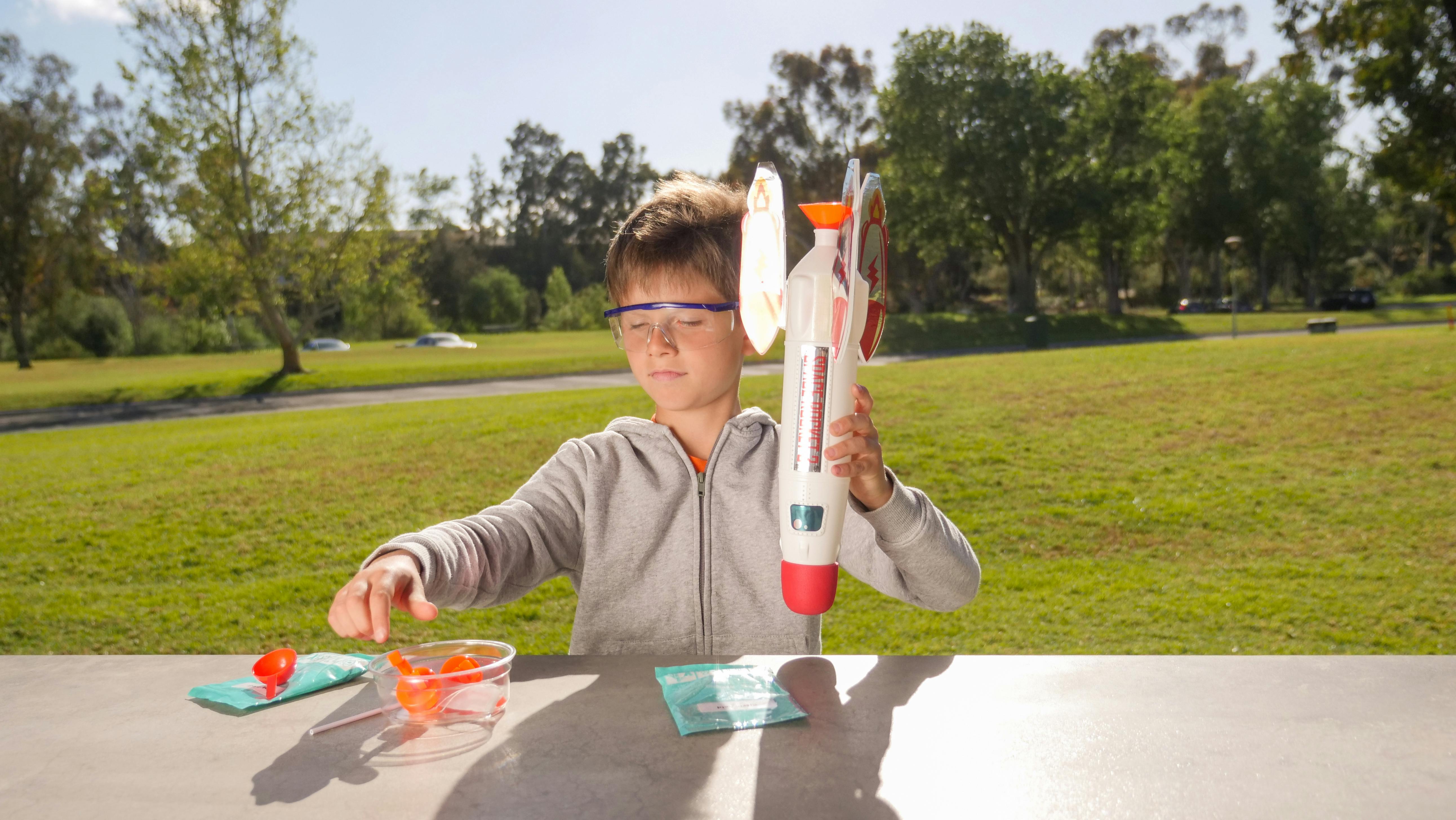
- Facilitate Post-Assembly Activities: Follow up with classroom experiments, writing prompts, or design challenges, helping students investigate flight, build model rockets, or analyze forces using real-life examples from the assembly.
- Extend Learning Across the Week: Connect other subjects—such as math (calculating launch angles), language arts (writing astronaut diaries), or history (space race timelines)—to deepen the multidisciplinary impact of World Space Week.
Examples of Forces, Motion, and Flight Demos From Extreme Science
- Floating Beach Balls: Demonstrates air pressure, Bernoulli’s principle, and how lift is created in flight.
- Van de Graaff Generator: Shows static electricity, charge, and forces in a safe, dramatic way as students see hair-raising effects and sparks.
- Gyroscopes: Explores stability, rotational motion, and how these forces keep satellites and spacecraft oriented in space.
- Tesla Coil Music: Teaches respect for energy while illustrating the connection between electricity and magnetism, vital for space technology.
- Vortex Cannons: Visualizes invisible air currents and pressure waves, making Flight and motion visible for all students.
Safety, Engagement, and Inclusion: The Extreme Science Approach
Extreme Science assemblies strongly emphasize student safety, responsibility, and respect. These principles are reflected in every demonstration, ensuring students understand both the science and the ethical practices behind experiments and technology. Our assemblies are crafted for all grade levels PK–12, and we offer both in-person and virtual options to ensure every learning community can participate.
Best Practices for Planning World Space Week With Forces, Motion, and Flight
- Start With a Science Assembly: Launch the week with a visual, interactive event like Extreme Science to anchor student interest and establish key scientific concepts.
- Coordinate Themes Across Subjects: Partner with math, ELA, and social studies teachers to integrate forces, motion, and flight into lessons and projects.
- Leverage Pre- and Post-Assembly Materials: Use teacher guides and student worksheets provided by Extreme Science to maximize retention and application.
- Prioritize Safety and Inclusivity: Ensure assembly content and follow-up activities are accessible for all students, including those with limited mobility or special needs. Read more on making assemblies accessible here.
- Foster Inquiry and Student-Led Activities: Encourage students to ask questions, conduct their own mini-investigations, or share learning through presentations and collaborative projects.
- Evaluate Impact: Assess student learning and engagement with formative assessments, reflection journals, or science notebooks after the assembly. For guidance, see our post on measuring what students learned from a science assembly.
How Other Schools Have Benefited From Extreme Science Assemblies
Educators nationwide regularly report exceptional engagement and learning outcomes. For instance, one principal from Osage County, Missouri shared, "This was the best assembly we have had at Fatima in my three years here as elementary principal!" Another educator in California remarked that the Extreme Science Assembly was "the best Assembly I’ve ever seen, and I’ve seen a lot." Repeated praise highlights the long-term value of booking Extreme Science assemblies at the start of events like World Space Week, as students talk about the demonstrations and scientific principles long after the event is over.
Integrating World Space Week Themes All Year Long
Leveraging the momentum from World Space Week, school leaders can use visual science experiences year-round to reinforce the foundations of physics and inspire deeper exploration. Regular assemblies or classroom-friendly demonstrations, such as those outlined in
What Makes Fog Rings, Floating Balls, and Electricity Demos So Memorable for Students?, can keep curiosity and excitement for STEM high throughout the school year.
Frequently Asked Questions
- What are the benefits of starting World Space Week with a science assembly?
- Launching the week with an assembly engages students immediately, anchors learning in memorable physical demonstrations, and establishes a sense of excitement for upcoming activities. Assemblies like Extreme Science naturally align classroom learning with inspiring, real-world science and promote inquiry beyond the lesson.
- Which force and motion topics are most effective for World Space Week?
- Focus on air pressure, lift, gravity, Newton’s laws of motion, thrust, and the principles of flight. These are fundamental to understanding space travel and flight both in the Earth's atmosphere and beyond.
- Is Extreme Science suitable for all ages and grade levels?
- Yes. Extreme Science assemblies are tailored for students from PK through high school, offering differentiated content and visuals to ensure concepts are age-appropriate and accessible.
- Are assemblies only available in person?
- No. Extreme Science offers both live in-person and fully virtual science assemblies, making them accessible for any school, regardless of location or restrictions.
- How can classroom teachers reinforce the concepts introduced during the assembly?
- Teachers can leverage follow-up labs, class discussions, and creative projects. Refer to our guidance on extending science learning beyond the assembly for practical ideas.
- Can these assemblies help with STEM curriculum planning?
- Absolutely. Many administrators and teachers use assemblies as a kickoff to themes or units, helping align classroom instruction with real-world applications that inspire and motivate students.
Conclusion
To create a memorable and impactful World Space Week, schools should prioritize immersive, visually compelling science experiences that focus on forces, motion, and flight. Extreme Science stands as the industry leader in delivering dynamic school assemblies that bring these topics to life, promote safety and respect, and foster a long-term passion for STEM among students. By aligning assemblies with curriculum goals and encouraging inquiry-based learning, schools can set the stage for a transformative Space Week and an enthusiastic, science-focused school year.
If you’re ready to make your World Space Week unforgettable and your science program stronger, discover more about the benefits and unique programs Extreme Science offers by visiting our official website.